


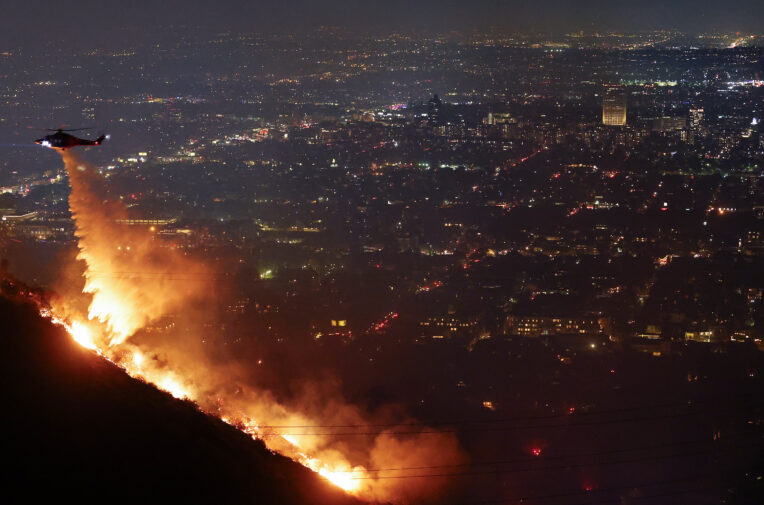
Los Angeles, California, January 2025: A firefighting helicopter drops water as the Sunset Fire burns in the Hollywood Hills with evacuations ordered on January 8, 2025 in Los Angeles, California. Photo: Mario Tama/Getty
The best environmental journalism of 2025
These are the stories we wish we’d published this year, as chosen by the Unearthed team
The best environmental journalism of 2025
These are the stories we wish we’d published this year, as chosen by the Unearthed team
Los Angeles, California, January 2025: A firefighting helicopter drops water as the Sunset Fire burns in the Hollywood Hills with evacuations ordered on January 8, 2025 in Los Angeles, California. Photo: Mario Tama/Getty
Green to Grey: How Europe is squandering the little nature it has left. Arena for Journalism in Europe and NRK: Zeynep Sentek, Jelena Prtoric, Hazel Sheffield, Léopold Salzenstein
Europe is losing an area of nature equivalent to 600 football pitches to development every day, this innovative cross-border investigation found. For years, the loss of the Amazon rainforest has been tracked. Now for the first time, a similar exercise has been conducted in Europe, using an AI model to scrutinise satellite imagery, and on-the-ground reporting. It identified developments such as luxury hotels, golf courses, warehouses, housing and more swallowing 9,000 km2 of natural and agricultural spaces between 2018 and 2023. The project led to stories across Europe such as this one in Finland about tourism destroying Lapland’s wilderness, and this one in Turkey about wetlands being swallowed up for luxury yacht facilities and an industrial gas hub.
Boy Wasted. Ends Report: Tess Colley, Pippa Neill, JournalismFundEurope: Lucy Taylor, Dan Ashby, Adnan R. Khan, De Groene Amsterdammer
Afghan refugees working in Turkey’s recycling industry are dying in disturbing numbers, often sorting British waste, this grim and important investigation found. Boy Wasted is both a true crime podcast and an environmental investigation that searches for answers into the death of Arifullah Fazli, a boy whose body was found shredded in a bale of plastic. Soon, the journalists find that hundreds of boys and men have died like him, while others are working in highly dangerous conditions and living in fear of deportation. It’s sobering listening about the human cost of waste exports.
Thousands of potentially illegal sewage spills in first half of 2025. The Times: Adam Vaughan
Not since the “Great Stink” of 1858 has there been so much public controversy over where our effluents end up. This Times piece nailed a key aspect of the problem that’s often glossed over. While it’s perfectly legal for water firms to dump raw sewage into rivers following heavy rain – a chronically overused safety mechanism supposed to prevent the whole system from crashing – it’s potentially illegal to do so on dry days. The Times showed that almost 8,000 potentially illegal spills happened on dry days during the first half of 2025. A great example of what the combination of freedom of information and data analysis can achieve.
Burning Rubber: The poisonous afterlife of waste tyres. SourceMaterial and the BBC
In 2022, India banned the import of waste tyres for pyrolysis – using extreme heat to convert tyres into cheap fuel. But this SourceMaterial and BBC File on 4 investigation found that as many as 50 million British tyres could be being used for pyrolysis illegally in India each year.
Using tracking devices planted by an industry insider, the reporters traced tyres from Southampton to an Indian port. Trucks then took them 800 miles on to a small village next to grimy pyrolysis plants, where tyres were fed into furnaces. Accidents are common at pyrolysis plants. They produce carcinogenic soot and toxic fumes, and locals report dying crops and contaminated water.
Recycling lead for US car batteries is poisoning people. The Examination and the New York Times: Peter S. Goodman, Will Fitzgibbon and Samuel Granados
Just outside Nigeria’s capital, the town of Ojigo is the continent’s biggest hub for lead recycling. Its factories supply major US carmakers with recycled lead, used in making batteries for electric vehicles. But the lead smelters are poisoning their workers, as well as the communities who live directly alongside them. More than 70 people in Ojigo volunteered to have their blood tested for this ambitious investigation, a collaboration between The Examination and the New York Times. The testing revealed dangerous levels of lead in the blood of every factory worker, and more than half the children.
Russia’s Blacklisted Tankers Keep Dumping Oil in Europe’s Seas. SourceMaterial and Politico: Victor Jack, Costanza Gambarini and Louise Guillot
This investigation revealed how Russia’s sanctions-dodging “shadow fleet” of oil tankers is polluting European waters with near impunity. Using satellite imagery and shipping data, reporters identified at least five Russia-linked tankers that leaked oil then continued to sail in European waters. The investigation exposes the limits of Western governments to enforce sanctions, and the environmental threat posed by Russia’s flotilla of aging, opaque, under-insured tankers.
UK Supermarket Seabass Linked to Devastating Overfishing in Senegal. DeSmog: Hazel Healy and Brigitte Wear. The Guardian: Karen McVeigh
In this classic chain-of-custody investigation, DeSmog and The Guardian worked for two years to demonstrate how demand for farmed fish in British supermarkets is contributing to food insecurity and unemployment in west Africa. Reporters traced how industrial fishing vessels off the Senegalese coastline harvest small fish like sardinella, and grind them into fishmeal. This is shipped to Turkish fish farms, where it feeds sea bass and sea bream that end up in British supermarkets. But the sardinella are an important part of people’s diets in Senegal’s coastal communities, and the overfishing is collapsing the local industry: this investigation reveals the human impact of the global trade in farmed fish.
Inside the car industry’s lobbying – Democracy for Sale: Lucas Amin
Major carmakers scored a lobbying victory when the Conservative government watered down the phase-out of petrol engines – but this only came to light after Democracy for Sale, a newsletter focused on corporate influence over politics, spent nearly two years arguing for the release of official documents. Minutes from meetings between the Conservative transport minister and carmakers showed how manufacturers argued that the phase-out should be delayed from 2030 to 2035, and that smaller companies should be exempted – both positions the government came to adopt.
Bolivia Burning: Inside a Latin American Ecocide – The Gecko Project
In this visually striking investigative documentary, human rights lawyer Álvaro Bozo García and journalist David Hill travel through Bolivia’s Chiquitano dry forest, the region worst affected by fires and deforestation. They document burn-scarred landscapes in the eastern lowlands, uncover newly established Mennonite colonies clearing vast tracts of forest for soya and other crops, and interview Indigenous Monkoxi communities on the front lines of the crisis. These on-the-ground findings are reinforced with satellite data, academic research and expert testimony, tracing destruction from local land grabs to national policy failures and global agribusiness supply chains. The investigation challenges official narratives and corporate sustainability claims, while centring Indigenous voices that expose the human cost of forest destruction.
The lasting toxic legacy of cargo ship disaster off Sri Lanka – Watershed and BBC: Leana Hosea and Saroj Pathirana
In July, the non-profit journalism team Watershed and the BBC uncovered the enduring environmental damage from a major cargo ship disaster off the coast of Sri Lanka in 2021, where billions of nurdles – tiny plastic pellets – washed up on shores. It was the biggest plastic spill ever recorded. Years afterwards, these nurdles continue to pose a threat to marine ecosystems, remaining deep in the sand despite clean up efforts and soaking up pollution like a “chemical sponge”, according to researchers. Analysis found traces of arsenic, lead and other metals on some of the most contaminated nurdles, leading to concerns around the impact this might have on marine organisms if ingested.
What the US Government Is Dismissing That Could Seed a Bird Flu Pandemic. ProPublica: Nat Lash
When an outbreak of bird flu tore through poultry farms in Ohio and Indiana at the end of 2024, farmers were forced to cull millions of chickens. Soon huge piles of dead birds appeared outside farms in the area. By mid-March, 20 million chickens across two states were dead. This investigation traced the spread of the virus and, using genetic mapping, wind simulations, satellite imagery and property data, found it was likely to be airborne, upending the US government’s longstanding theory that bird flu is spread by wild birds and tracked into barns with lax biosecurity. More detail on the fascinating (for nerds like us) methodology here.
Rats, flies and maggots: a community plagued by 25,000 tonnes of illegal waste. Sky News: Rachael Venables
Sky News’ investigation into a towering illegal waste dump at the end of a row of terraced houses in Wigan pulled out all the stops to show its impact on the local community. Drone footage and satellite imagery reveals the scale and growth of the site while on-the-ground reporting tells the shocking experiences of residents, including people who have been assaulted when attempting to confront workers on the site. When the heatwave hit in July, a fire at the dump burned for nine days, leaving children unable to attend school and residents hit by infections or even hospitalised. The Environment Agency said that they are dealing with the site “as quickly as possible”.