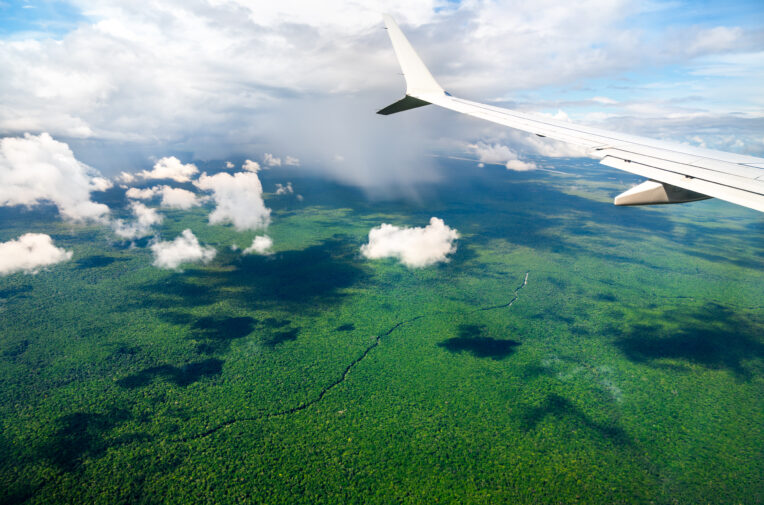
The wing of a plane is seen flying over the Amazon rainforest. Photo: Leonid Andronov / Getty
UK ‘green’ jet fuel imports linked to illegal Amazon deforestation
US biofuels producer supplying UK with sustainable aviation fuel has sourced beef tallow linked to illegal deforestation of a conservation area
UK ‘green’ jet fuel imports linked to illegal Amazon deforestation
US biofuels producer supplying UK with sustainable aviation fuel has sourced beef tallow linked to illegal deforestation of a conservation area
The wing of a plane is seen flying over the Amazon rainforest. Photo: Leonid Andronov / Getty
A major supplier of ‘green’ airline fuel to the UK has sourced beef fat linked to illegal Amazon deforestation, court documents and shipping data show.
Because the UK government designates industrial grade beef fat, known as tallow, as ‘waste’, the green fuel industry’s most widely used sustainability certification scheme does not assess whether the cattle it derives from were raised on illegally deforested land.
US biofuels producer Diamond Green Diesel (DGD) uses Brazilian tallow, as well as waste fats from other sources, to make sustainable aviation fuel, or SAF, and has sent regular shipments of the green fuel to the UK since January 2025. But DGD imports beef tallow from a Brazilian rendering factory that has been supplied by a slaughterhouse operator linked in multiple court cases to illegal deforestation, Unearthed’s new investigation, in collaboration with a team of journalists supported by Journalismfund Europe, can reveal.
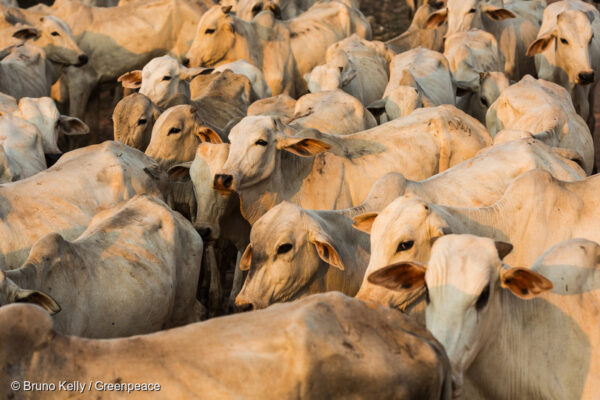
Tallow can be used as a feedstock for biofuels, and is extracted by grinding bones, some organs and fatty trimmings into a coarse slurry, stewing it at high heat and spinning it in high-speed centrifuges.
DGD claims that its green fuels reduce lifecycle greenhouse gas emissions by 80% compared to conventional jet fuel.
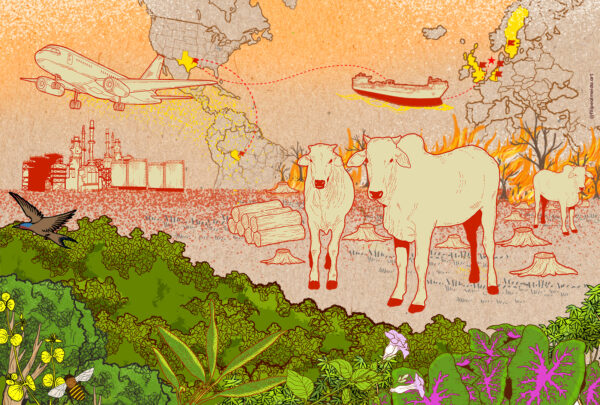
As governments increasingly mandate that fossil-based fuels be blended with biofuels to reduce carbon emissions, demand for greener fuels is rising – including in the UK, where jet fuel must now contain 2% SAF, rising to 22% by 2040.
DGD is a joint venture between Valero, a major fuel producer, and Darling Ingredients, one of the world’s largest rendering companies. DGD sources tallow and other waste fats, such as used cooking oil, from multiple countries.
DGD’s imports of tallow from Brazil have increased sharply since 2022, and a 2025 Repórter Brasil and Reuters investigation linked the company to Amazon deforestation via two other Darling-owned rendering plants.
Now our investigation has identified a third rendering plant in DGD’s Brazilian tallow supply chain that has been supplied by a slaughterhouse found to have sourced cattle from ranches that have illegally felled portions of the Amazon, court documents and trade data shows. In Brazil, deforestation is the leading driver of greenhouse gas emissions.
There is no suggestion that the companies involved were aware of deforestation at farm level. Rather, the findings suggest a traceability gap in the supply chain of feedstocks for sustainable fuels, where cattle by-products are subject to less oversight than the primary commodities of the cattle industry, such as meat and leather.
Cian Delaney, biofuels campaigner at Transport & Environment, said the findings were “frustrating and disappointing from a climate perspective.”
“There is clearly an oversight within the rules if the products, in this case animal tallow, are originally coming from deforested land,” he said.
Neither Valero nor DGD responded to requests for comment. Darling’s spokesperson said that the animal agriculture supply chain was “extremely complex,” and that the company was “in the process” of requiring all suppliers to “attest that their material is deforestation free.”
Deforestation at the root of the supply chain
The Jaci-Paraná extractive reserve, in Rondônia state, was carved out of the rainforest in 1996 for rubber tappers and Brazil nut collectors to use sustainably. More than three-quarters of its forest have since been lost to pasture, as large swathes have been illegally deforested for beef production.
Rondônia’s state attorney’s office is currently suing local slaughterhouse operator Distriboi over allegations it has bought cattle from illegal farms inside Jaci-Paraná.
Distriboi is named in 31 lawsuits filed by the attorneys related to land-grabbing and deforestation in the reserve. In 2024, a Rondônia court found against Distriboi in one of these cases, ordering the company to pay damages to reforest a swathe of the reserve. Distriboi denied wrongdoing in that case in legal filings, according to an AP report. Legal filings show that initial hearings have found against Distriboi in at least two other cases. The decisions are still subject to appeal.
Pacífico Indústria e Comércio, a local rendering factory, buys leftover parts of cattle carcasses for tallow extraction from slaughterhouses. A 2022 court document from a labour dispute names Distriboi as Pacífico’s “largest supplier of raw materials.” Pacífico, in turn, supplies DGD with tallow, trade data shows.
As well as joint-owning DGD, Darling Ingredients is also a parent company to Pacífico since its 2022 acquisition of Brazilian rendering company FASA Group. Darling’s expansion into Brazil, which has more cattle than any other country, has provided DGD with a steady supply of tallow, during a period of growing demand for waste fats.
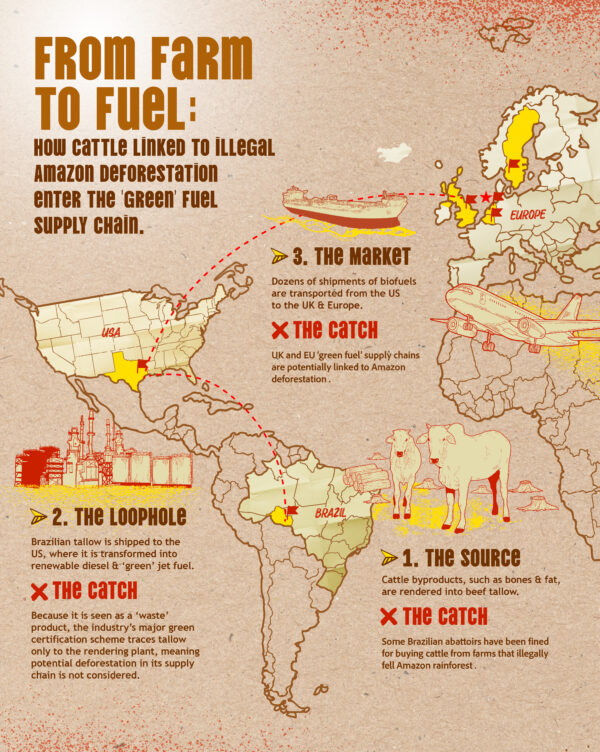
From 2023 to 2025, DGD imported 15,000 tonnes of tallow from Pacífico to Texas, where it has a refinery transforming feedstocks such as tallow and used cooking oil from various countries and sources into renewable fuels.
A spokesperson for Darling Ingredients denied that Pacífico sources beef residues from Distriboi’s Ji-Paraná slaughterhouse.
“The rendering plant Pacífico does not source any materials from the slaughterhouse Distriboi in Ji-Paraná,” the spokesperson wrote in an email response.
Distriboi operates two slaughterhouses in Rondônia. Darling did not respond to a follow-up question about Distriboi’s other slaughterhouse in the region, which according to cattle transfer documents has also bought from a farm that has illegally cleared forest within the extractive reserve.
The Darling spokesperson added: “Our relationships are typically with the slaughterhouse, several levels removed from cattle ranchers. Regardless, we are committed to ensuring our raw materials are deforestation free. We expect our raw material suppliers to abide by our supplier code of conduct. In addition, we are in the process of requiring we are in the process of requiring all of [sic] raw materials to attest that their material is deforestation free.”
Lawyers for Distriboi said that the “matters mentioned, which refer to the Distriboi meat processing plant, are already under review, including by higher courts”.
Local Indigenous activist Neidinha Suruí, who featured in the 2025 Emmy Award-winning documentary ‘O Território, said that the damage deforestation has caused to the natural environment in Jaci-Paraná extractive reserve has been “devastating.”
“It is sad to see what has been lost,” she said.
She added: “Environmental crime only exists because there are companies that buy products derived from environmental crime. If there were no meat processors buying illegally sourced cattle, there would be no land grabbing and no deforestation.”
Cattle ranching is by far the biggest driver of Amazon deforestation, and industry research and market experts suggest that beef processing margins are so slim that every revenue stream is essential to an abattoir’s commercial survival – even the by-products sent for tallow extraction.
A 2023 Repórter Brasil report noted that cattle by-products accounted for 12% of the revenue of Brazilian meatpackers in 2020, adding that this revenue is often what separates profit from loss for the sector.
Tight margins are long-standing: a Brazilian agribusiness consulting firm concluded in 2017 that “the meatpacking company’s profit is only possible through the sale of all its main products and by-products.”
Demand for feedstocks like tallow has rapidly increased over the past five years, in a phenomenon critics have dubbed a global “fat-grab,” driven by policies mandating that biofuels are blended with conventional fossil fuels to reduce their emissions.
“The global push for more biofuels made from waste oils, such as sustainable aviation fuel and renewable diesel, has rapidly created a demand for feedstocks that are inherently limited in supply,” said Delaney, from T&E, adding that the investigation raised “important questions about how upstream environmental impacts should be allocated to downstream by-products and residues.”
“As demand and economic value for these by-products increase, potentially approaching those of the main product, such as meat…they may need to carry a corresponding share of environmental impacts, including deforestation,” he said.
Overall imports of tallow from Brazil to the US have soared over the past five years, from under 10,000 tonnes in 2021 to almost 400,000 tonnes last year, according to Panjiva.
Waste or commodity?
Aviation makes up 7% of all UK carbon emissions and more than a quarter of the country’s transport emissions. It is also a particularly difficult sector to decarbonise: unlike road transport it cannot be easily electrified, and extreme safety requirements can slow the adoption of new technologies.
SAF is the most immediate solution, and the UK has brought in a mandate for its use, under which jet fuel must contain 2% SAF by the end of 2025, rising to 10% by 2030 and 22% by 2040.
Most renewable fuel suppliers rely on a certification of sustainability to prove their environmental credentials. In the UK, the green fuel industry’s most widely used voluntary certification scheme – the International Sustainability and Carbon Certification (ISCC) – is obliged to follow domestic legislation. Because the UK designates tallow as a waste product, the start point of the supply chain for ISCC auditors is the rendering plant – not the farm.
This allows tallow from cattle to qualify as a sustainable feedstock for green fuels, even if the animals were raised on illegally deforested land.
But forests store vast amounts of carbon; when they are cut down or burned this carbon is released into the atmosphere. If deforestation linked to a biofuel’s feedstock is not taken into account, this calculation could be flawed, experts said.
“If the cattle supplying fat were raised on land converted from a high carbon stock area, illegally deforested, the resulting tallow would likely render the biofuel ineligible under these strict sustainability criteria, regardless of its emissions calculation,” said Haniyeh Hajatnia, an academic specialising in lifecycle assessment for sustainability at the University of Bath.
The ISCC said it “applies the definitions and accounting rules set by the relevant legislation.”
“In this context, classifying tallow as a waste/residue and designating the ‘point of origin’ at the rendering plant follows the logic established in the regulatory framework,” a spokesperson explained. “This approach is based on the principle that the main purpose of livestock farming and slaughterhouses is not the production of tallow, and that associated by-products are therefore treated differently in greenhouse gas accounting.”
The Department for Transport did not provide an on-the-record response.
From Texas to Wales and beyond
In the UK, Valero, DGD’s joint-owner, operates the Texaco brand, and is positioning itself as a key player in the UK’s transition to lower-carbon fuels. The company has been an active participant in UK SAF policy discussions, opposing a proposed levy on fuel suppliers, and criticising the government’s planned cap on waste fat sources in SAF. Valero said that waste fats were “the world’s most cost-effective production route for SAF” in submissions to parliament.
In 2025, DGD shipped 134,000 tonnes of sustainable aviation fuel (SAF) from Texas to the UK, with a value of $89m (£67m) according to trade data from Panjiva.
The SAF supply chain within the UK is opaque. Typically, when SAF arrives in the UK it is blended with conventional jet fuel at a refinery or fuel terminal, next it is often transported through national pipelines to airport fuel farms, where it mixes with fuels from other suppliers, making its source invisible to the end consumer. It can also be trucked to airports – particularly smaller ones, without pipeline access.
Valero did not respond to requests for comment. But its UK infrastructure suggests that DGD’s Texas-produced SAF could have reached UK airports.
Of DGD’s 10 SAF shipments last year, at least six arrived at Milford Haven waterway, where Valero owns and operates a refinery producing jet fuel, among other products. In 2018, it also acquired a fuel storage facility, the Valero Pembrokeshire Oil Terminal, just across Milford Haven from its refinery at Pembroke. Valero also holds interests in pipeline networks supplying the UK with fuel directly from Milford Haven.
Valero supplies, or has supplied, conventional aviation fuel to major airports across the UK, according to information in the public domain.
‘Too many blindspots’
SAF and renewable diesel emit roughly the same amount of carbon dioxide as their fossil fuel counterparts when burned; their “low-carbon” label depends on life-cycle emissions. Plant-based feedstocks absorb CO2 from the atmosphere as they grow, while tallow is considered sustainable because it is considered a waste product.
As SAF usage in the UK, and elsewhere, rises, oversight of sourcing will be crucial to ensure that such mandates are effectively lowering emissions and not driving land-use change, said Anna Krajinska, a director at Transport & Environment UK.
“If there’s tallow coming from land that’s been deforested, then those emissions might be so high that you might not be getting to the greenhouse gas reduction threshold,” she said.
It is unclear whether there is a systemic problem with illegal deforestation in the tallow supply chain for biofuels, and some experts say SAF is the only viable means to reduce aviation emissions at present, even if flawed.
“It would be important to assess how large this infraction is,” Professor Wouter Dewulf, aviation economist at the University of Antwerp, said. He added that: “It’s the best alternative for the moment [but] I’m quite sure you have aberrations.”
Delaney, from T&E, said there needs to be less opacity and better oversight from regulatory authorities.
“Right now, there are just too many blindspots.”
A version of this story appeared in Climate Home and Repórter Brasil