


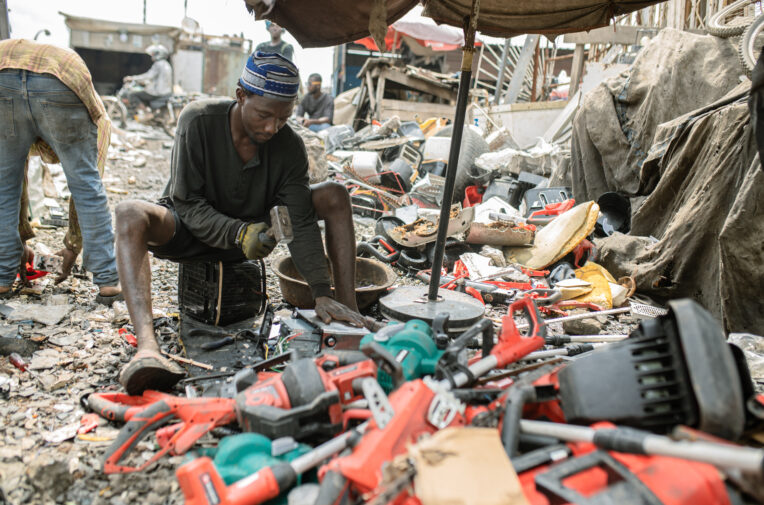
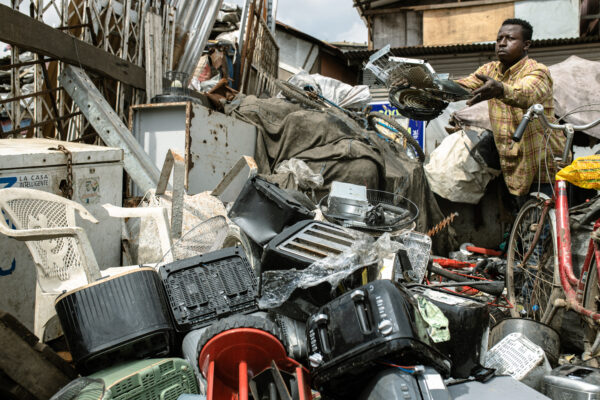
A worker strips a George at Asda toaster at Agbogbloshie, June 2026. Photo: Michael Kofi Takyi for Unearthed/Greenpeace Africa
Faulty appliances returned to UK supermarkets found at e-waste dump in Ghana
Broken electrical items returned to Tesco, Asda and Argos were illegally shipped to Africa, a joint Unearthed and Greenpeace Africa investigation found.
Faulty appliances returned to UK supermarkets found at e-waste dump in Ghana
Broken electrical items returned to Tesco, Asda and Argos were illegally shipped to Africa, a joint Unearthed and Greenpeace Africa investigation found.
A worker strips a George at Asda toaster at Agbogbloshie, June 2026. Photo: Michael Kofi Takyi for Unearthed/Greenpeace Africa
In the centre of Ghana’s capital, Accra, lies Agbogbloshie: a tract of land flanking the Odaw river that was once ranked alongside Chernobyl as one of the most polluted sites on earth.
Agbogbloshie has historically been one of the world’s biggest digital scrapyards. Muddy tracks snake between mounds of electronic waste and shacks for informal recycling. Workers, mostly young men from Ghana’s arid north, hunch over discarded toasters, slow cookers and strimmers, smashing open plastic casings with mallets, and yanking out fistfuls of wiring. Everything of value is extracted; the rest is burnt or dumped. Acrid fires dot the riverbank, burning mounds of plastic insulation and other detritus.
Jumbled among the piles of waste on four visits to the site conducted by Unearthed and Greenpeace Africa were some strikingly familiar sights: boxes of small appliances – dozens of them – from British retailers including Tesco, Argos and George at Asda. Many bore returns labels showing they had been returned to high-street stores on the grounds that they were faulty.
Exporting broken electrical goods from the UK to Africa is illegal in almost every circumstance, and Ghana’s environmental regulator said that broken European electrical appliances “should not be here”.
But Unearthed’s investigation, in partnership with Greenpeace Africa, suggests that goods returned to UK shops are being sold off in bulk and shipped untested, by middlemen, to Ghana.
Here, there is a thriving market in electrical appliances that have been discarded by British retailers, as well as second-hand goods: they are seen as desirable by local shoppers, and even share the same plugs. These are often sold as being untested, without any guarantee that they work. Items that cannot be repaired or that do not sell end up at Agbogbloshie.
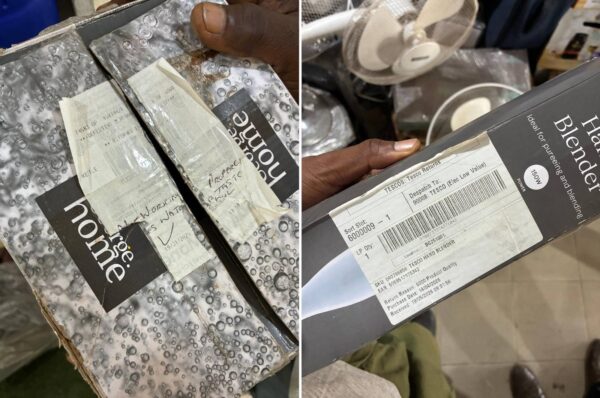
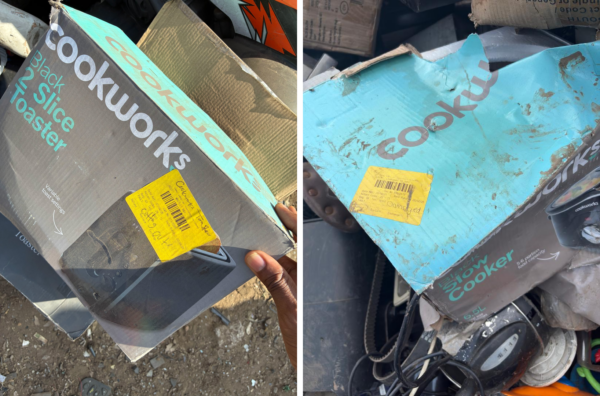
The findings suggest that faulty goods are ending up being exported illegally from the UK to countries where the absence of formal recycling infrastructure means that e-waste can cause severe harm to the environment and to the health of surrounding communities.
After being presented with our findings, Tesco said it had suspended its third-party e-waste management providers “with immediate effect” while it carries out a full audit of their practices.
Argos said it took the findings seriously, while Asda referred us to the British Retail Consortium, a trade association, which called the findings “deeply concerning”.
“Ghana is not a dumping ground for broken appliances or failed retail returns from the UK,” said Joshua Awuku-Apaw, a Ghanaian environmental consultant. “Shipping faulty, non-functional kitchen appliances abroad under the cover of ‘reuse’ or ‘second-hand trade’ shifts the financial, environmental, and health costs of overconsumption onto Ghanaian communities and workers… Ghana’s communities should not bear the health burden of UK retail waste.”
Everything must go
Over multiple trips to the dump site and to nearby electrical goods stores, we documented dozens of toasters, slow-cookers, kettles and more from Argos, Tesco and George, many still in their boxes. The quantity of appliances grouped together suggests they were shipped in bulk.
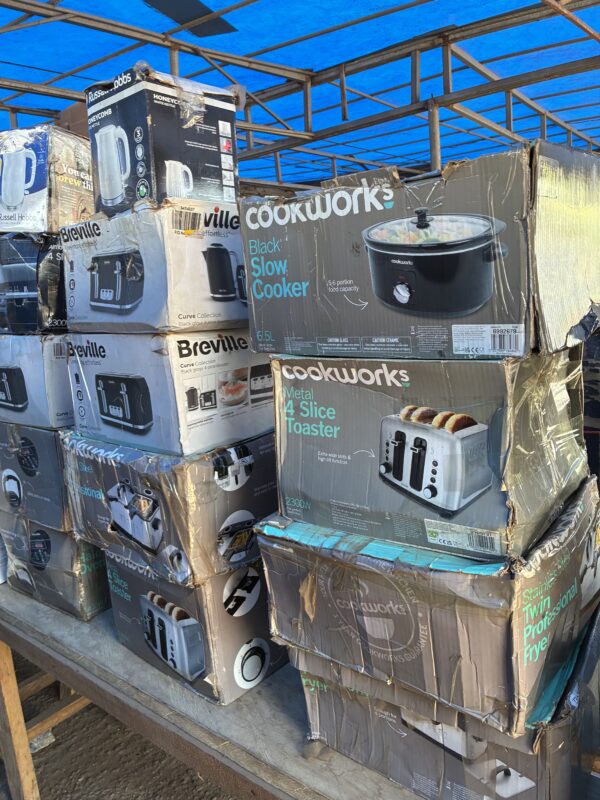
A toaster bore a returns slip saying “not working” from Tesco’s Sandhurst Extra store. A second had been returned due to “product quality”. Not everything was returned as faulty: two Crock-Pot slow cookers with Tesco returns labels noted a “change of mind”. In another jumbled pile of appliances two metres high, two Tesco toasters, two Tesco ceramic slow cookers, and at least eight Crock-Pots are visible.
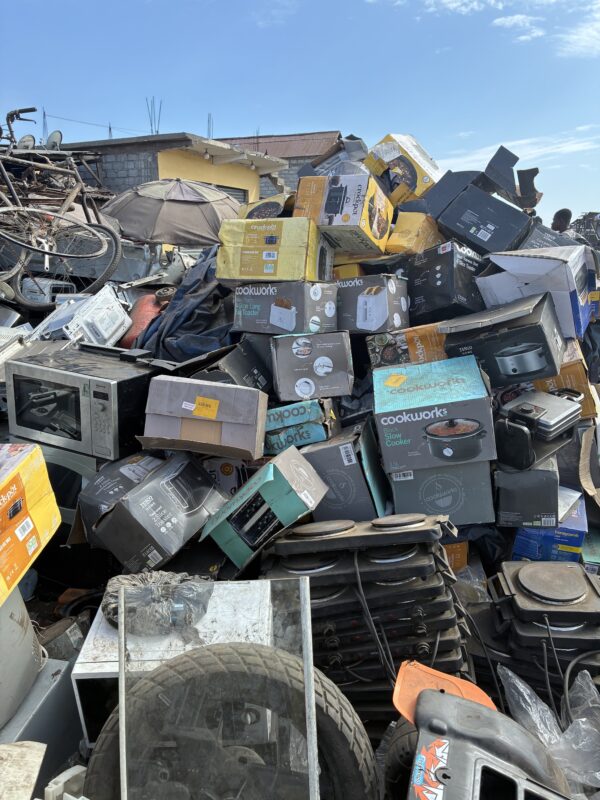
The same pile of e-waste contained at least nine boxed items from Cookworks, an Argos own brand. A Cookworks toaster had been bought at Whitley Bay Argos and returned on the same day in April. The fault read “cutting out”. A Cookworks slow-cooker from Taunton was returned for “not heating up”. Multiple George Home toasters, an Asda own-brand, can also be seen in heaps of waste, some unboxed with yellow logistics labels and others with Asda till receipts taped to them.
We tested nine returned Tesco, Argos and George items marked as faulty from secondhand shops and the dump site; only one worked. Some of the items we found in Agbogbloshie and second-hand stores had stickers labelling the goods as “untested return”.
Through field trips, open-source reporting and almost two dozen interviews with industry experts and those involved in the trade, we established that after being returned to high street retailers, these faulty items are likely to have been sold off through liquidation channels to “jobbers”. These are individuals and small businesses who buy the goods by the palletload and set about extracting any value they can, whether by listing items individually on eBay or Vinted, selling them at discount stores, or exporting them.
Argos runs its own liquidation site, Argos Clearance, which auctions pallets of returns – including household electricals.
An Argos Clearance auction ending last week advertised six pallets of “small kitchen appliances RETURNS”, including more than 200 items, such as toasters, blenders, slow-cookers and microwaves, described as “raw customer returns that have NOT been checked or tested for faults (mainly faulty).”
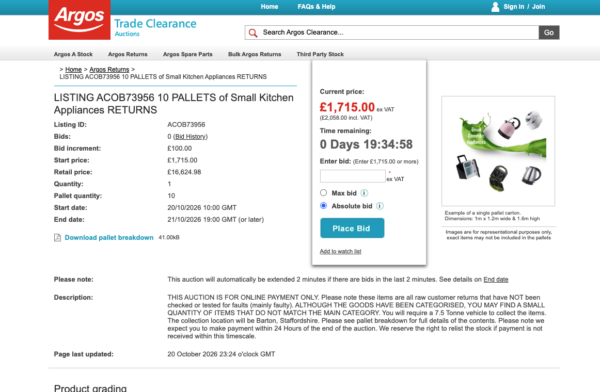
Argos Clearance’s terms state that buyers must repair, rework, recycle or resell items as second-hand, have electrical items tested by a qualified electrician before resale, and comply with e-waste rules. But Argos declined to tell us how it monitored or enforced these conditions, or if it had ever acted against a buyer for breaching them.
Other retailers appear to operate through independent liquidation wholesalers – for example, the investigation found a job lot of Tesco returns listed on an auction site.
None of the retailers directly responded to questions over whether faulty electrical returns were sold off through liquidation channels, instead of being processed as e-waste.
However, Unearthed and Greenpeace Africa found online evidence of a thriving market reselling returns from major retailers. Lively TikTok videos show UK-based middlemen advertising scores of pallets of returned goods as suitable for export to Africa and the Middle East. Some describe their pallets as ‘Tesco small appliances’ or ‘Customer return mix Pallet kitchen appliances for Export’. Another broker advertised “Asda onlin [sic] return pallets for export”.
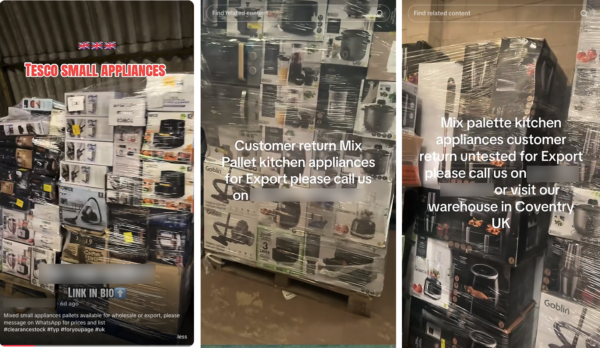
We approached several of these companies, posing as potential buyers. One broker based near Derby told us their pallets of small appliances “come directly from Tesco” and are £300-700 each.
“You’ll have some brand new, some faulty,” a salesperson said. “The reason it works for Africa is because… it doesn’t cost a lot of money to fix it, you know what I mean?” They estimated that 80% of their exports currently go to Africa.
A second broker told us he had a variety of kitchen items, and they were “all Asda, George Home.”
“If you’re interested, I’ve got… kettle pallets, then we have the mixed pallets, mixed items – can be deep fryers, air fryers, microwaves, water dispensers, irons, stand mixers,” he said. “Most of our stuff is raw returns, untested.”
This broker also described how – unusually – a client shipping a lorry-load of equipment to Ghana earlier in the year had “needed a few [items] testing”. The broker said, “It was a bit of a headache trying to sort it out for him… but we got it done in the end”.
Shopkeepers in Ghana, whose names we have changed to protect their livelihoods, told our undercover reporters they typically work with a contact based in the UK. “The percentage of unusable products varies… it can be about 10%,” said Emmanuel. “What do I do with the broken ones? I put them in this box and the Agbogbloshie boys come to collect them.”
“We sell untested items that we buy wholesale… about 30% of it is waste and that’s why it’s cheaper,” said Accra shopkeeper Kofi. “If you buy a bulk of items and they’re not working – from our side, they are not returnable… And also for our customers, when they buy from us, they are also not returnable… we all lose money.”
One sustainability expert for a British household appliances firm, who asked not to be named, told Unearthed his company had decided not to sell on its returned small electrical goods, such as kettles and toasters, to liquidators – even though it would have recouped money.
“We could have sold those products off to a jobber, but one thing we couldn’t do was get a guarantee that anything that didn’t work wouldn’t get shipped overseas… it was really important to us that the stuff didn’t go outside the UK, so we didn’t lose control of it.”
“There are all sorts of auction sites that will sell off pallet loads of unprocessed returns from various sources,” he said. But “the last thing that we want to see is a picture of somebody on a waste site somewhere in Africa holding one of our products. Because that clearly reflects on us as a brand, and people will understandably ask us: well, how did it get there?”
Jim Puckett, founder of Basel Action Network, which campaigns against the export of e-waste to poorer countries, said that treating untested returns as anything other than waste was a “major loophole.”
“It should be considered waste until proven otherwise,” he said. “Especially if people are buying it at auction or whatever and shipping it all around the world.”
A Tesco spokesperson said: “We’re extremely concerned about these claims. We have suspended our third-party electronic waste management providers with immediate effect while we complete a full audit of them and their practices.
“We remain committed to removing or reducing the waste across our operations wherever we can and we work closely with experts to ensure we handle materials responsibly, in line with legal requirements and our own robust standards.”
Argos said: “As a responsible retailer, we have processes in place for products returned to Argos. We take these findings seriously and are reviewing the information provided to establish what further action is needed to ensure our requirements are met.”
Asda did not respond to questions about what it did with its returned goods, but provided a statement from the British Retail Consortium, a trade association: “Retailers take their responsibility to tackle electrical waste seriously, so reports of faulty electronics being dumped in Ghana are deeply concerning. Used electronics should only be exported for legitimate reuse where they are safe and functional and must not place the burden of dealing with UK waste on communities overseas. We also need greater investment in the UK’s recycling infrastructure so more electrical waste can be safely reused and recycled here.”
An electrical wasteland
Many of the domestic appliances shipped to Ghana through this route are bought and put to use in local homes. However, those that cannot be sold end up contributing to the toxic sprawl of Agbogbloshie; we documented dozens of such items at the dump site.
Agbogbloshie is a product of the changing ways in which we make, buy and use electronic and electrical goods. Small appliances such as blenders that were once a significant outlay, kept for years and repaired, can now be bought for the cost of a pizza. “Fast tech” goods – USB cables, handheld fans and so on – sell on the high street and the internet for a few pounds. Even expensive items, such as phones and laptops, are routinely replaced when they slow down or break.
A record 62 million tonnes (Mt) of e-waste was produced worldwide in 2022, up 82% from 2010, according to the UNITAR Global E-waste Monitor – a quantity that would fill enough 40-tonne lorries to encircle the equator. Global e-waste is predicted to rise another third, to 82Mt, by 2030.

But less than a quarter of 2022’s e-waste, by mass, was properly collected and recycled. The rest ends up in landfills, or is processed informally, sometimes in dangerous conditions like Agbogbloshie.
“I worry so much about the way the boys dismantle the e-waste and set it on fire to salvage metals with no protective gear in the midst of the toxic fumes. They all breathe it, and the toxic chemicals go all over their body as well – and even beyond where they are working. This is very dangerous,” said Julius Fobil, a leading Ghanaian environmental and occupational health scientist at the University of Ghana.
“The wider community is at risk, even the food, water, and air,” he added. “For the developed countries, they are solving their problem. Everybody knows that recycling e-waste properly and responsibly is expensive, so for the advanced countries, they are getting rid of their problem by sending the e-waste to Ghana.”
Toasters, kettles and slow-cookers are classified as non-hazardous e-waste by the British authorities, said Puckett, of Basel Action Network, but that doesn’t mean breaking them down is harmless.
“Even a non-hazardous electronic item can create huge hazards, of course, when you burn it,” Puckett said. The plastic housing of an appliance, for example, releases carcinogenic dioxins when burned, he explained. “Don’t let anybody tell you that these toasters and cookers are not going to cause harm. As soon as they’re processed in a horrific way – they will.”
Daniel was ten when he started working at Agbogbloshie, Africa’s largest e-waste site. Now 27, he earns a few pounds a day breaking open discarded electronic appliances to recover valuable metals such as copper and aluminium. Informal recycling is precarious, hazardous labour. The workers rarely use protective equipment beyond, perhaps, a single glove, and commonly report burns, back problems, and infected wounds, as well as respiratory problems, chronic nausea, and headaches. Daniel attributes long-term health issues to his years at the site.
“Because of the things we burn here and the smoke, we have catarrh, your body aches, and we itch all the time,” he added. “The sickness here doesn’t come in a day – it develops gradually in your body and you will think it’s normal.”
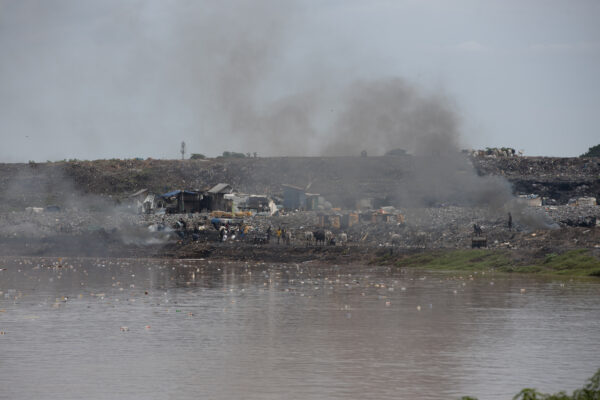
The impacts of informal e-waste processing are well-documented. One study of workers at the site have found lead levels two-thirds higher than US safety benchmarks, while children at schools within a kilometre of Agbogbloshie show elevated metal levels, with blood lead levels high enough to be associated with cognitive deficits. A study published in February found that babies born close to sites like this are more likely to die before their first birthday.
A single egg from a chicken raised in Agbogbloshie would exceed EU safety limits for dioxins, carcinogens released by burning plastic, 220 times over.
Locals said they were worried about the impact of the pollution. A watermelon seller at the neighbouring Agbogbloshie food market, who gave her name as Aunty Mary, complained about the smoke drifting over her goods. “When they burn, the smoke goes all over and we inhale the black smoke,” she said.
Needle in a haystack
The problem of e-waste from the Global North ending up at sites like Agbogbloshie has received international attention in recent years, and an international convention on waste dumping has been expanded to try and block the practice. The Basel Convention, a 35-year-old international treaty limiting the ability of rich countries to dump their waste on poorer ones, was expanded at the start of last year to include measures on e-waste.
Under the new rules, since January 2025, most non-hazardous e-waste – a category that includes most domestic small appliances – can only be shipped abroad with the consent of both the UK government and that of the receiving country. Environment Agency (EA) data shows that no such consents have been granted for Ghana – or any other African country – in that timeframe.
E-waste handed into retailers and manufacturers, or collected at council-run recycling centres, goes into an official system known as obligated e-waste. This is regulated by the Environment Agency (EA) and can count towards retailers’ official recycling targets.
Tesco’s website stated that it recycled its faulty products through these official “obligated” e-waste channels. But our reporting has established that e-waste handled in this way has no legal route to Ghana.
Obligated e-waste can be sent overseas for processing – but only by EA-approved exporters, to sites that the EA has judged to meet UK standards. The EA told Unearthed, through an FOI, that no such exporter has been permitted to send e-waste to Ghana, or anywhere in West Africa, for at least the past three years.
The most likely route by which the domestic appliances could have reached Ghana is by being described as items for reuse, rather than being designated as waste. However under UK rules, used electrical equipment can only be exported for reuse if every item has been tested and shown to work, with a record of its test attached. The shipment must also come with paperwork showing the equipment is destined for reuse, and a declaration from the exporter that none of it is waste. We did not see any records of testing attached to any British appliances on sale in Accra – some had stickers saying “untested return” – and eight of the nine items we tested did not work.
The UK’s e-waste rules are robust, but cannot account for items that are never officially designated as waste, said Mark Sayers, director of the waste compliance consultancy CircuMetrics.
Just because a returned appliance is recorded as “not working” by a supermarket, “doesn’t always mean they’ve technically declared it as a waste,” he said.
“The regulations simply say you can’t ship waste for disposal to non-OECD countries, which means you can’t send waste to Ghana,” he said. “But simply by mislabelling it [as a product rather than waste] at the very top end of that value chain, you can circumvent all of it.”
The EA is responsible for stopping illegal waste exports from England, but experts agree it cannot physically check more than a fraction of what leaves UK ports. Identifying shipments that could contain misclassified appliances would mean the authorities are looking for “a very small needle in a very, very big haystack”, said Sayers.
Misclassification is a “common vulnerability”, said Nancy Isarin, an environmental crime consultant for UNDP. “If the shipment is not selected for inspection, authorities may only see the customs declaration and supporting documentation… A container may contain hundreds or thousands of appliances,” she said.
Unearthed understands that between January 2025 and 23 October 2026, the EA inspected 35 containers destined for Ghana, five of which were stopped after e-waste was identified. Four of the shipments were subsequently deemed illegal waste shipments.
The EA said: “Illegal waste exports are a serious crime. There is no excuse for exporting waste to be dumped or landfilled overseas. Waste leaving England must be sent for legitimate recovery or recycling.”
Larry Kotoe, acting director for sustainability at Ghana’s Environmental Protection Authority, told us that the international trade in functional second-hand electrical goods “provides important economic and social benefits”, but it is aware of “longstanding concerns regarding the potential export of non-functional and end-of-life electrical products under the guise of reusable equipment”. In almost all circumstances, importing broken electrical goods to Ghana is illegal. “If they are not working, [they] should not be here,” he said.
Passing on items that are still working to be used again is important for minimising waste, experts stressed.
“Some returned products can be repaired, refurbished or safely returned to use, and these routes should be encouraged.” said Sam Corp, head of regulation at the Environmental Services Association (ESA), a trade body for the waste and recycling industry. “However, there must be a clear distinction between genuine reuse and the onward sale of faulty or untested goods without adequate checks.”
He added: “Incidents like this emphasise the importance of the legal duty of care businesses have over the waste they produce.”
Puckett said that while the exporters are largely to blame, as they are the ones “intentionally skirting the rules,” retailers have a responsibility to do their due diligence. “They cannot assume that whoever they give it to is going to be doing things properly. It is ultimately on them to make sure that their downstream is compliant with all the laws,” he said.
“It is not sufficient for companies to pass their waste to an intermediary and hope that it is handled and treated responsibly further down the line,” added Corp, of ESA. “Proper safeguards must be in place to ensure that the waste does not fall into the wrong hands or end up harming the environment and communities at home or abroad.”