


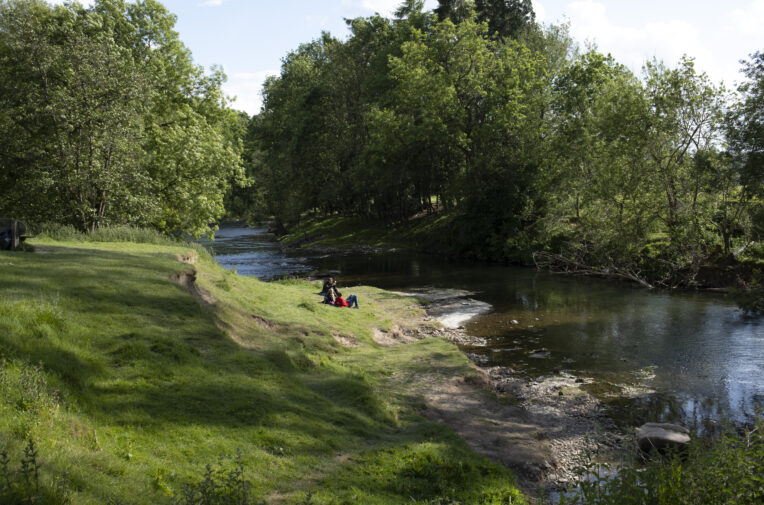
Traces of TFA were found at testing location along the River Teme, a site of special scientific interest.
Toxic ‘forever chemical’ found in almost all rivers and groundwaters tested in England
Experts say the Environment Agency’s testing exercise found concerning levels of the manmade chemical TFA.
Toxic ‘forever chemical’ found in almost all rivers and groundwaters tested in England
Experts say the Environment Agency’s testing exercise found concerning levels of the manmade chemical TFA.
Traces of TFA were found at testing location along the River Teme, a site of special scientific interest.
A “forever chemical”, which Europe’s chemicals regulator says may damage babies in the womb and is suspected of harming fertility, has been found in rivers and groundwater across England, according to Environment Agency data obtained exclusively by Watershed and Unearthed.
A leading expert in the field said the results found in rivers and groundwater, which could be used for crops and sources of drinking water, were some of the worst results seen around the world.
These are the first tests of Trifluoroacetic acid (TFA) to be carried out by the Environment Agency (EA), and the first time it has been tested for in England’s groundwater. The substance was found in every surface water sample and almost 90% of the groundwater sampled.
The TFA that is on the Earth today will be on the Earth for the next thousand years
Professor Hans Arp
TFA is a type of PFAS – per- and-polyfluoroalkyll substances, a family of manmade chemicals that are mobile, toxic and highly persistent in the environment. TFA is produced when other PFAS – including pesticides, refrigerants and industrial chemicals – degrade.
TFA has been the subject of scrutiny from scientists and regulators in recent years due to concerns about how long it remains in the environment and its potential impact on human and environmental health. Recent studies have raised concerns about “irreversible accumulation” of TFA almost everywhere in the environment.
“The TFA that is on the Earth today will be on the Earth for the next thousand years, and the TFA concentrations we see now are probably the lowest we’ll see in your lifetime,” says Professor Hans Arp, an environmental chemist at the Norwegian University of Science and Technology and an expert on TFA.
The UK currently does not have limits for TFA, but the EU chemicals agency in June recommended it be classified as toxic to reproduction, and this year the European Food Safety Authority significantly lowered its health-based tolerable daily intake limits.
The EA’s tests have detected TFA in all 50 surface‑water samples and 43 out of 49 groundwater samples. At 40% of the surface waters tested, TFA was above 2,200 ng/l, a level that would breach the EU’s new limit for PFAS in rivers and lakes if TFA were the only PFAS present. Currently, limits around TFA are calculated alongside the sum of 24 other PFAS. The European Commission has said it will consider a TFA-only limit for surface waters in its next review.
The EU is yet to set specific guidelines on levels of contamination from TFA in groundwater, but will do so in the next legislative review. There are, however, limits on pesticide breakdown products – which TFA would fall under. This limit is 100 ng/l, meaning that 86% of groundwater samples in the study would be in breach.
The EA data covered 40 rivers and other surface waters. The highest concentrations were recorded in the River Ancholme in Lincolnshire, at 6,412 ng/l. Five of the rivers where TFA was detected are designated Sites of Special Scientific Interest (SSSI) including the River Wensum, a rare chalk river habitat, with over 100 plant species and a rich variety of wildlife.
The highest reading across all water bodies – 10,202 ng/l – was detected in groundwater near Finchingfield in north Essex. These are the first groundwater samples ever tested for TFA in the UK, and the peak value detected is comparable to the upper end of findings by the Swiss federal authorities’ national groundwater monitoring programme. The Swiss exercise detected two samples above 10,000 ng/l out of almost 550 sites, which the authorities described as “exceptionally high”.
An Environment Agency spokesperson said: “We are taking action to improve our understanding of chemicals in the environment to protect our rivers, groundwater and drinking water catchments.
“This includes monitoring emerging evidence, including information on traces of chemicals in the environment, sources and potential impacts.”
It’s irreversible and that’s one of the main classifiers for a planetary threat
Hydrologist Professor Patrick Byrne
Professor Arp said the results of the EA’s testing are among the worst sets of data he had seen.
“Groundwater has always been viewed as a source of clean [drinking] water. When, for instance, your lake becomes polluted, it was always the Plan B. So when I see that groundwater is starting to be polluted, it just means that there’s not a plan B,” says Professor Arp.
Professor Arp has been studying the levels of TFA in Austria’s groundwater and found that it has doubled in the last five years, which he says is a shocking trend – but he adds that there is no reason to believe this is specific to Austria.
‘There’s absolutely no way around this’
A major source of TFA is F-gases, which were brought in to replace ozone-depleting gases in refrigeration, air conditioning, aerosol sprays and heat pumps. PFAS pesticides can also break down into TFAs, as can dyes and pharmaceuticals.
“This is the exact type of PFAS that we talk about raining down on us, going back into the hydrological cycle, being evaporated up and raining down. It’s irreversible and that’s one of the main classifiers for a planetary threat, or exceeding a planetary boundary,” explains hydrologist Professor Patrick Byrne of Liverpool John Moores University.
Commonly applied water treatment processes cannot remove TFA, posing a challenge for water protection.
“We have a substance that could potentially be harmful to reproduction and it is in everything you drink and eat, because we put it there and we continue to put it there. The concentration will continue to go up, there’s absolutely no way around this. If you do not stop the inputs, the concentration will go up,” said David Behringer, an environmental consultant who has studied TFA in rain for the German government.
Traces of TFA have been found in fruit, vegetables and wine, and particularly high levels have been found in cereals. TFA was also detected in all blood samples of 110 people in Europe.
German authorities have highlighted that elevated TFA levels tend to occur in agricultural regions and areas influenced by wastewater.
The EU banned the herbicide flufenacet in 2025, due to its potential to contaminate groundwater with TFA at levels that “significantly exceed the statutory limit”. Flufenacet is still widely used on crops including wheat and barley in Britain.
Emissions of refrigerant gases that degrade into TFA have been increasing in the UK and Europe. Car air conditioning is one of the clearest sources of TFA. In 2017, car manufacturers switched to using a refrigerant gas (called HFO-1234yf), which researchers have found may be a leading cause of TFA.
Last year, research from the University of York found TFA in 31 out of 32 rivers sampled, including some of the highest concentrations ever recorded globally in the River Kelvin in Scotland, at 78,464.2 ng/lL.